Loading ...

Search Results

Free Shipping on orders of $49+ | Signup for Direct Rewards
Free Shipping on orders of $49+ | Free Store Pickup | Signup for Direct Rewards
Free Shipping on orders of $49+ | Signup for Direct Rewards
Free Shipping on orders of $49+ | Free Store Pickup | Signup for Direct Rewards

When we ask how big is the ocean, our immediate impulse is to look at a flat map. We note that blue covers most of the globe and assume we have the answer.
In reality, measuring the ocean requires thinking in three dimensions. To truly grasp its scale, you have to look beyond flat surface area and account for immense liquid volume, vertical depth zones, and the varied marine ecosystems thriving miles below the surface.
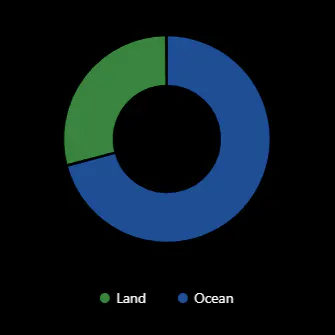
The ocean covers approximately 71 percent of Earth’s surface. In absolute terms, the total ocean surface area spans roughly 139 million square miles (361 million square kilometers).
To put that into perspective, all seven continents combined occupy only about 57 million square miles (148 million square kilometers). You could fit every landmass on Earth into the ocean's footprint, and you would still have tens of millions of square miles of open water left over.
While mapmakers divide this saltwater blanket into named basins, scientists treat it as one continuous, interconnected global ocean. Seawater moves freely around the globe through the global ocean conveyor belt, transferring heat, nutrients, and gases across planetary distances.
Measuring surface area only tells half the story. The total ocean volume is what makes our planet truly aquatic.
Earth’s oceans hold approximately 1.335 billion cubic kilometers (roughly 321 million cubic miles) of water. This accounts for about 97 percent of all water on Earth, with the remaining 3 percent locked in ice caps, glaciers, groundwater, lakes, and the atmosphere.
A single cubic mile of water equals more than 1.1 trillion gallons. Multiplying that across hundreds of millions of cubic miles yields an amount of liquid that defies everyday human scale. If all Earth’s land were smoothed out to a uniform elevation, the ocean would cover the entire globe to a depth of nearly 9,000 feet (2,700 meters).
According to the National Oceanic and Atmospheric Administration (NOAA), the average ocean depth is approximately 12,100 feet (3,688 meters) - more than two miles down.
The seabed is not a smooth bowl. It begins with the gently sloping continental shelf, plunges down the continental slope, levels out into wide abyssal plains, and is split by underwater mountain chains like the Mid-Ocean Ridge, which stretches over 40,000 miles across the globe.
The deepest part of the ocean is Challenger Deep, located at the southern end of the Mariana Trench in the western Pacific Ocean. Challenger Deep reaches approximately 35,876 feet (10,935 meters) below the surface—nearly seven miles down.
If you placed Mount Everest (29,032 feet / 8,849 meters) at the bottom of the Mariana Trench, its peak would still sit more than a mile below the surface of the water.
Geographers traditionally recognize five ocean basins: the Pacific, Atlantic, Indian, Southern, and Arctic.
A common statistic claims that humans have explored only 5% of the sea. The reality is more nuanced: it depends on what you mean by "explored."
Exploring the deep sea remains difficult because seawater blocks sunlight, absorbs radio and GPS signals, drops to near-freezing temperatures, and exerts immense hydrostatic pressure.
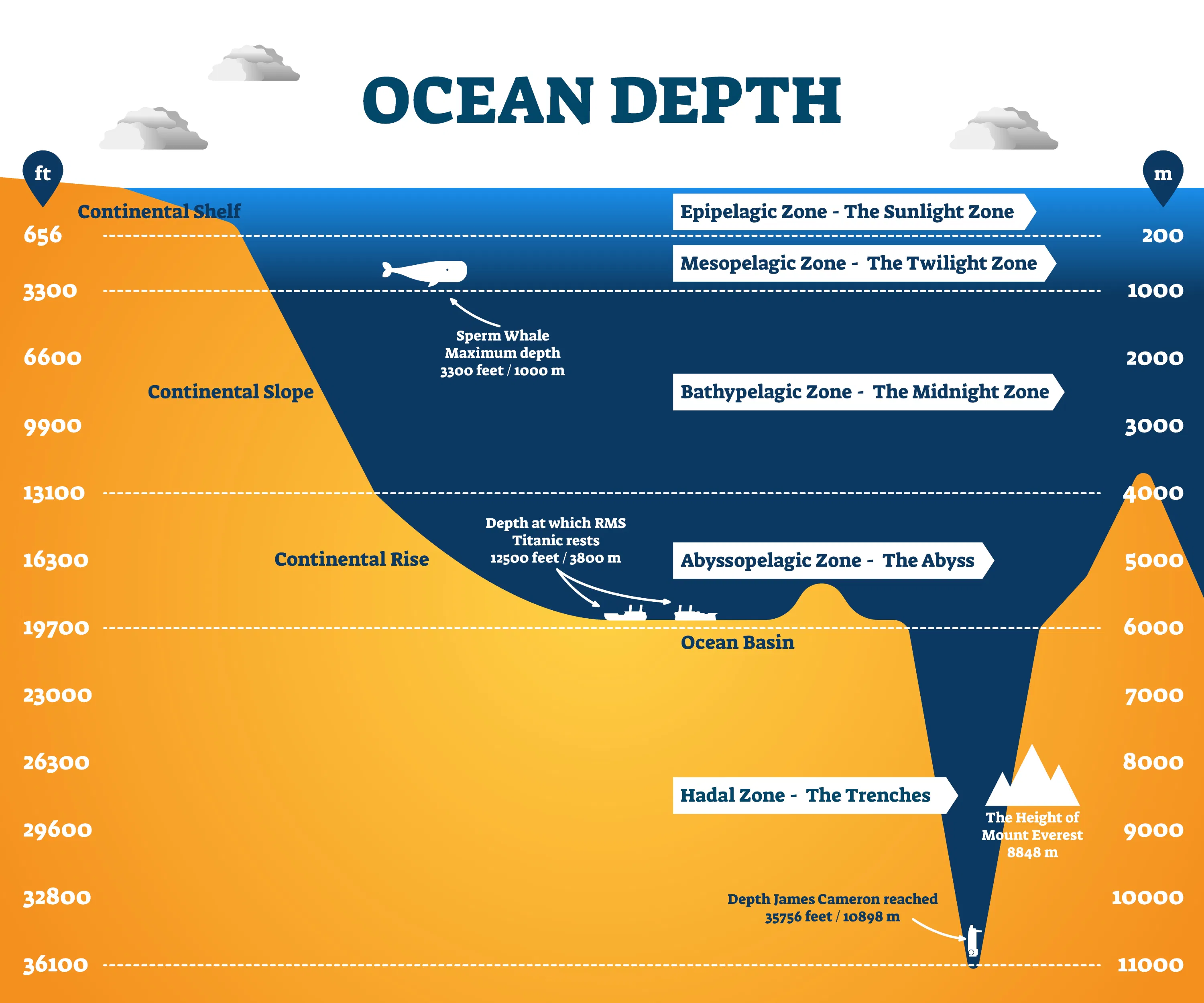
Vertical depth determines an environment's light, pressure, and temperature. Marine scientists divide the water column into five major vertical ocean zones:
The ocean is Earth's largest habitat, home to an estimated 700,000 to one million species, though only roughly 240,000 have been formally described by science.
Less than 0.1 percent of the seafloor is actually covered by coral reefs.
Yet tropical coral reefs support an estimated 25 percent of all marine species. Reef-building corals require warm, clear, shallow water to feed the symbiotic algae (zooxanthellae) in their tissues, concentrating an extraordinary amount of Earth's biodiversity into a tiny fraction of its total seafloor.
For beachgoers, swimmers, and divers, wildlife sightings depend heavily on habitat, geography, water temperature, and season.
The deep sea is an environment of intense physical forces:
The size of the ocean is essential to keeping Earth habitable.
Whether studying deep trenches or paddling across coastal reefs, understanding the physical size and depth of our oceans gives us a clearer picture of the systems that sustain our planet. At Divers Direct, our connection to the water fuels our commitment to understanding, exploring, and protecting these vital marine environments.
The ocean covers about 139 million square miles (361 million square kilometers), or roughly 71% of Earth's surface. Land accounts for only 29% (57 million square miles). All continents combined could fit comfortably inside the Pacific Ocean alone.
Surface area measures the two-dimensional expanse of open water (139 million square miles), whereas ocean volume measures the total three-dimensional quantity of water contained within that basin—roughly 1.335 billion cubic kilometers (321 million cubic miles).
Challenger Deep, located within the Mariana Trench in the western Pacific Ocean, is the deepest known spot on Earth at approximately 35,876 feet (10,935 meters) below the surface.
Although shallow coral reefs occupy a fraction of one percent of the sea floor, they shelter, feed, and support roughly one-quarter of all known marine species, making them some of the most biodiverse and ecologically important habitats on Earth.